
Executive Summary
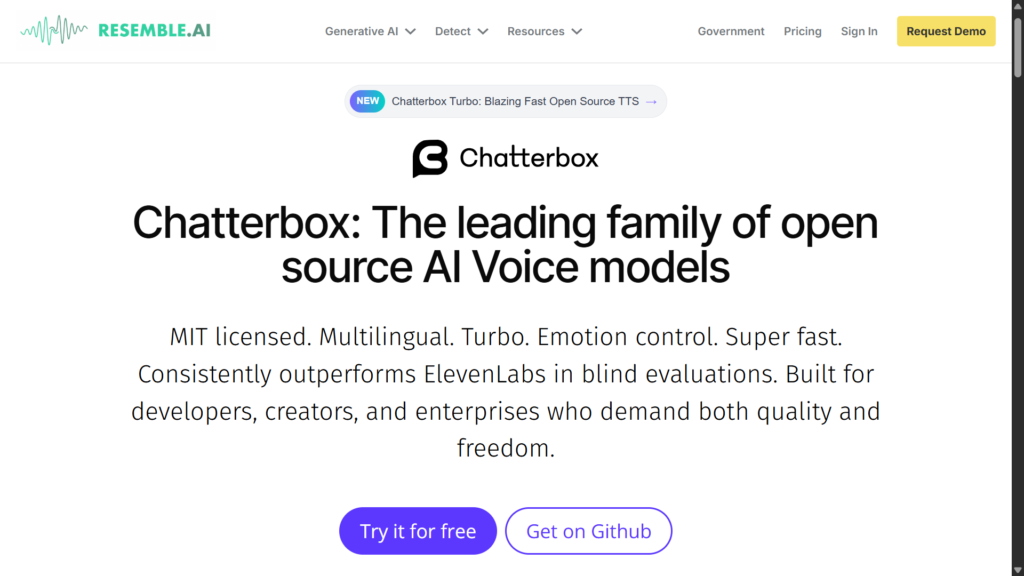
Chatterbox is a family of state-of-the-art, open-source text-to-speech (TTS) Apps developed by Resemble AI. Released under the permissive MIT license, Chatterbox has rapidly become one of the most significant developments in the open-source voice AI space. Within weeks of its initial release, it achieved over 1 million downloads on Hugging Face and surpassed 11,000 GitHub stars, demonstrating extraordinary community adoption.
What sets Chatterbox apart is its unique combination of production-grade quality, complete transparency, and features typically reserved for expensive commercial solutions—all available for free with no usage restrictions.
The Chatterbox Family
Resemble AI has developed three distinct models, each optimized for specific use cases:
1. Chatterbox (Original)
The flagship model that started it all. Built on a 0.5 billion parameter Llama architecture, it offers high-quality voice synthesis with emotion control and zero-shot voice cloning. Trained on 500,000 hours of curated audio data, it delivers professional-grade results suitable for production environments.
Best for: General-purpose TTS, content creation, audiobooks, and applications requiring high-quality voice synthesis
2. Chatterbox Multilingual
Extends the original model’s capabilities to 23 languages, including Arabic, Chinese, Danish, Dutch, English, Finnish, French, German, Greek, Hebrew, Hindi, Italian, Japanese, Korean, Malay, Norwegian, Polish, Portuguese, Russian, Spanish, Swedish, Swahili, and Turkish.
Best for: Global applications, multilingual content, language learning tools, international customer service
3. Chatterbox Turbo
The newest and most efficient model, featuring a streamlined 350 million parameter architecture. Turbo reduces the speech-token-to-mel decoder from 10 steps to just 1 through distillation, achieving sub-200ms latency for real-time applications. It natively supports paralinguistic tags like [laugh], [chuckle], [cough], and [sigh] to add natural vocal reactions.
Best for: Real-time voice agents, interactive applications, live dubbing, conversational AI with minimal latency requirements
Key Features & Capabilities
Zero-Shot Voice Cloning
Chatterbox can clone any voice using just 5-10 seconds of reference audio—no training required. This makes personalized voice generation accessible to anyone without requiring machine learning expertise or expensive compute resources.
Revolutionary Emotion Control
Chatterbox is the first open-source TTS model to offer emotion exaggeration control. Users can adjust emotional intensity from flat/monotone (0) to dramatically expressive (2.0+) with a single parameter. This allows for:
- Monotone delivery for technical content
- Natural conversation for chatbots
- Dramatic narration for audiobooks
- Excited or enthusiastic tones for marketing content
Paralinguistic Tagging (Turbo)
The Turbo model supports text-based tags that generate natural vocal reactions in the cloned voice:
[laugh]– Natural laughter[chuckle]– Light chuckling[cough]– Realistic coughing[sigh]– Expressive sighing- And more
These reactions maintain the same emotional tone and voice characteristics, requiring no post-processing or audio splicing.
Built-in Watermarking
Every audio file generated by Chatterbox includes Resemble AI’s PerTh (Perceptual Threshold) neural watermarker. This imperceptible watermark:
- Survives MP3 compression and audio editing
- Maintains nearly 100% detection accuracy
- Helps trace synthetic audio origins
- Promotes responsible AI deployment
Ultra-Fast Performance
- Chatterbox Original: Faster than real-time inference
- Chatterbox Turbo: Sub-200ms latency, ideal for real-time applications
- Streaming Support: Community implementations achieve 0.499 realtime factor on RTX 4090, with first chunk latency around 472ms
Voice Conversion
Beyond TTS, Chatterbox includes tools for voice conversion—transforming existing audio recordings from one voice to another while maintaining natural quality.
Technical Architecture
Model Specifications
- Original: 0.5B parameters, Llama-based architecture
- Turbo: 350M parameters, distilled decoder
- Training Data: 500,000+ hours of cleaned, curated audio
- Framework: PyTorch with CUDA/MPS/ROCm support
- Python Version: 3.11 (recommended)
- Inference: Alignment-informed generation for stability
Hardware Requirements
- Minimum: CPU (slower but functional)
- Recommended: NVIDIA GPU with CUDA support (8GB+ VRAM)
- Also Supports: AMD ROCm, Apple Silicon MPS
- Turbo Model: Lower VRAM requirements than original
Installation
Simple pip installation:
pip install chatterbox-tts
Or clone from source:
git clone https://github.com/resemble-ai/chatterbox.git
cd chatterbox
pip install -e .
Basic Usage Example
import torchaudio as ta
from chatterbox.tts import ChatterboxTTS

# Load model
model = ChatterboxTTS.from_pretrained(device="cuda")

# Generate speech
text = "Hello! This is Chatterbox speaking."
wav = model.generate(text)
ta.save("output.wav", wav, model.sr)

# Voice cloning with reference audio
wav_cloned = model.generate(
    text,
    audio_prompt_path="reference_voice.wav"
)
ta.save("cloned_output.wav", wav_cloned, model.sr)
Performance Benchmarks
Head-to-Head Comparison with ElevenLabs
Resemble AI conducted independent blind evaluations through Podonos, comparing Chatterbox against ElevenLabs—considered the industry benchmark. The results were striking:
63.75% of evaluators preferred Chatterbox over ElevenLabs when comparing naturalness and speech quality. Both systems used identical text inputs and 7-20 second audio clips in zero-shot mode without prompt engineering or audio processing.
Chatterbox Turbo Performance
Additional blind tests compared Chatterbox Turbo against ElevenLabs Turbo 2.5, Cartesia Sonic 3, and VibeVoice 7B, with Chatterbox consistently ranking at the top for naturalness and expressiveness.
Key Performance Metrics
- Latency: Sub-200ms (Turbo), faster than real-time (Original)
- Quality: Consistently ranks above competing models in blind perceptual tests
- Stability: Alignment-informed inference eliminates common artifacts and glitches
- Accuracy: Low Word Error Rate (WER) for transcription quality
Real-World Applications
Content Creation
- Podcasts & Audiobooks: Generate entire audiobooks in an author’s voice, create podcast episodes with consistent narration
- Video Voiceovers: Professional-quality voiceovers for YouTube, educational content, and marketing videos
- Social Media: Quick voice generation for TikTok, Instagram Reels, and other short-form content
Accessibility
- Screen Readers: Natural-sounding text-to-speech for visually impaired users
- Document Narration: Convert articles, PDFs, and books into audio format
- Educational Materials: Make learning content more accessible through audio
Entertainment & Gaming
- NPC Dialogue: Dynamic character voices with appropriate emotional context
- Interactive Storytelling: Expressive narration that adapts to story developments
- Character Voicing: Consistent voice acting for games, animation, and interactive media
Business Applications
- AI Voice Assistants: Expressive, natural voices for chatbots and virtual assistants
- Customer Service: Automated responses with human-like qualities
- IVR Systems: Enhanced phone systems with natural-sounding prompts
- Training Materials: Engaging e-learning content with varied vocal delivery
Language & Education
- Language Learning: Native-speaker pronunciation in 23 languages
- Educational Content: Engaging educational materials with emotion-matched delivery
- Pronunciation Training: Reference audio for language students
Development & Integration
- API Integration: OpenAI-compatible endpoints for easy migration
- Custom Applications: Embed TTS in apps, services, and workflows
- Research Projects: Academic and experimental AI voice applications
Deployment Options
Open-Source Self-Hosting
- Run locally on your own hardware
- Deploy on-premises for data privacy
- Complete control over infrastructure
- No usage limits or caps
Cloud Platforms
- Hugging Face Spaces: Instant testing via Gradio interface
- fal.ai: Cost-effective API access ($0.05-0.10 per request)
- Modal: Serverless deployment with GPU acceleration
- Google Colab: Free experimentation and prototyping
- DigitalOcean: GPU Droplets for production hosting
Community Tools & Extensions
- ComfyUI Integration: Custom nodes for TTS and voice conversion workflows
- Docker Containers: Pre-configured deployment with Helm charts
- FastAPI Servers: Self-hosted API endpoints with OpenAI compatibility
- Gradio Interfaces: User-friendly web UIs for non-technical users
Enterprise Options
For organizations requiring enhanced performance, fine-tuning, and support, Resemble AI offers:
- Custom model fine-tuning for brand voices
- Higher accuracy and precision
- Sub-200ms guaranteed latency
- Enterprise SLAs and support
- On-premises deployment assistance
Current Limitations & Considerations
Technical Constraints
- Speech Duration: Base model performs best with inputs under 40 seconds; longer generation may experience quality degradation (though extended implementations handle this via chunking)
- Language Performance: While multilingual, the model achieves highest naturalness and expressiveness with English inputs
- Reference Audio Quality: Optimal results require clean reference audio (10+ seconds, 24kHz+ sample rate, single speaker, minimal background noise)
- Computational Requirements: GPU recommended for reasonable performance; CPU inference is significantly slower
Parameter Tuning
- CFG (Classifier-Free Guidance): Affects pacing and speaking style; fast speakers may need lower values (~0.3)
- Exaggeration: Higher values speed up speech; balancing with CFG is important
- Language Matching: Reference audio should match target language to avoid accent transfer
Setup Complexity
- Initial setup requires technical knowledge (Python, PyTorch, CUDA)
- Documentation improving but still relies on community contributions
- GPU drivers and CUDA installation can be challenging for newcomers
Not Suitable For
- Real-time transcription (this is a TTS model, not speech-to-text)
- Extremely long-form generation without chunking strategies
- Applications requiring specific proprietary voice licenses
Ecosystem & Community
Rapid Adoption
- 1 Million+ downloads on Hugging Face within weeks
- 11,000+ GitHub stars demonstrating strong developer interest
- 3,000+ stars in first 48 hours of initial release
- Active Discord community for support and collaboration
Open Development
- MIT License: True freedom to use, modify, and distribute
- Public GitHub repository with active development
- Community contributions including:
- Streaming implementations
- Fine-tuning scripts (LoRA, GRPO)
- Extended versions for audiobook generation
- Apple Silicon optimizations
- Alternative API wrappers
- Integration with popular tools (ComfyUI, Modal, etc.)
Comparison with Alternatives
In the open-source TTS landscape, Chatterbox competes with:
- Dia (Nari Labs): 1.6B parameters, English-only, strong at dialogue
- Higgs Audio V2 (BosonAI): Built on Llama 3.2 3B, trained on 10M+ hours
- Orpheus (Canopy AI): Multiple sizes (3B to 150M), multilingual
- XTTS (Coqui): Popular established model
- VITS: Research-grade, high realism
Chatterbox differentiates through its balance of quality, efficiency, and unique features like emotion control, combined with strong benchmarks against commercial solutions.
Responsible AI Commitment
Watermarking Technology
Resemble AI’s PerTh watermarker embeds imperceptible neural watermarks that:
- Exploit psychoacoustic principles
- Encode data in frequency ranges masked by human perception
- Survive common manipulations (compression, editing, format conversion)
- Enable traceability of AI-generated content
Ethical Guidelines
The project includes clear guidelines:
- “Don’t use this model to do bad things”
- Built-in detection for synthetic content
- Transparent about capabilities and limitations
- Supports responsible deployment practices
Privacy Considerations
- Open-source allows data to stay on-premises
- No vendor tracking or usage monitoring
- Complete control over voice data
- No cloud dependency for basic functionality
Getting Started
Quick Start (Python)
# Install
pip install chatterbox-tts

# Import and use
from chatterbox.tts import ChatterboxTTS
model = ChatterboxTTS.from_pretrained(device="cuda")

# Generate
text = "Your text here"
wav = model.generate(text)
Try Online
- Hugging Face Space: https://huggingface.co/spaces/ResembleAI/Chatterbox
- Google Colab: One-click demos available in community repositories
Documentation
- GitHub: https://github.com/resemble-ai/chatterbox
- Hugging Face: https://huggingface.co/ResembleAI/chatterbox
- Official Site: https://www.resemble.ai/chatterbox/
Community Support
- Discord server for real-time help
- GitHub Discussions for technical questions
- Active subreddit and forum participation
The Future of Chatterbox
Recent Developments
- September 2024: Multilingual model released with 23 language support
- December 2024: Turbo model introduced with sub-200ms latency
- Continuous improvements to quality and performance
- Growing ecosystem of tools and integrations
Roadmap Considerations
While Resemble AI hasn’t published an official roadmap, community activity suggests:
- Further latency optimizations
- Expanded language support
- Enhanced emotion control granularity
- More paralinguistic tags
- Improved fine-tuning workflows
Industry Impact
Chatterbox demonstrates that open-source AI can compete with—and in some cases exceed—commercial alternatives. This trend is:
- Democratizing access to advanced voice AI
- Reducing costs for developers and creators
- Accelerating innovation through community collaboration
- Setting new standards for transparency in AI
Business Model & Sustainability
Dual Strategy
Resemble AI employs a balanced approach:
Open Source (Free):
- Core models available under MIT license
- No usage restrictions
- Community-driven development
- Self-hosting capabilities
Enterprise Services (Paid):
- Custom fine-tuning for specific voices/domains
- Enhanced performance guarantees
- Professional support and SLAs
- Managed hosting with ultra-low latency
- Integration assistance
- Compliance and security features
This model ensures sustainability while keeping the technology accessible to everyone, from individual developers to large enterprises.
Cost Economics
Open-Source Deployment
- Self-Hosted: Only infrastructure costs (GPU compute, electricity)
- Cloud APIs: $0.05-0.15 per generation (fal.ai, Modal)
- No Per-Character Pricing: Generate as much as your hardware allows
Comparison to Commercial Alternatives
- ElevenLabs: $0.30 per 1,000 characters (Professional plan)
- Google Cloud TTS: $4-16 per million characters
- Amazon Polly: $4-16 per million characters
- Chatterbox: $0 for self-hosted, 10-60x cheaper via APIs
For high-volume applications, the cost savings are substantial—potentially thousands of dollars monthly compared to commercial services.
Conclusion
Chatterbox represents a watershed moment in open-source voice AI. By combining enterprise-grade quality, groundbreaking features like emotion control, and true open-source freedom, it has challenged the assumption that the best AI tools must be proprietary and expensive.
The model’s rapid adoption—1 million downloads and 11,000 GitHub stars within weeks—demonstrates that the developer community was ready for a high-quality, transparent alternative to commercial TTS services. The fact that 63.75% of blind evaluators preferred Chatterbox over ElevenLabs validates that open-source AI can compete at the highest levels.
For developers, creators, and enterprises seeking voice AI solutions, Chatterbox offers:
- Quality: Production-grade output that rivals commercial leaders
- Freedom: MIT license with no restrictions or vendor lock-in
- Innovation: First-of-its-kind features like emotion control
- Economics: Free to use, dramatically lower costs than alternatives
- Transparency: Full access to code, models, and training details
- Community: Active ecosystem of contributors and tools
Whether you’re building the next AI assistant, creating engaging content, improving accessibility, or exploring voice AI research, Chatterbox provides the tools, freedom, and quality to bring your vision to life—without compromising on ethics, transparency, or your budget.
Additional Resources
Official Channels:
- GitHub: https://github.com/resemble-ai/chatterbox
- Hugging Face: https://huggingface.co/ResembleAI/chatterbox
- Website: https://www.resemble.ai/chatterbox/
- Discord: Available via GitHub repository
Tutorials & Guides:
- DigitalOcean Tutorial: Comprehensive setup and audiobook creation guide
- Modal Deployment: Quick serverless deployment guide
- Community Wikis: Step-by-step implementations
API Wrappers & Tools:
- chatterbox-tts-api: OpenAI-compatible FastAPI server
- ComfyUI nodes: Visual workflow integration
- Docker containers: Pre-configured deployments
Research & Benchmarks:
- Podonos evaluation reports
- Community performance comparisons
- Technical architecture discussions